
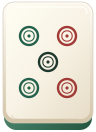
About this tile
The red five of dots was the first red tile, introduced in Japan in the 1970s, and many modern Japanese sets include two of them so groups can choose how many to use. In Taiwan it is nicknamed four dishes and a soup (四菜一湯). In riichi it is uu pin and fits 3-4-5, 4-5-6 and 5-6-7.
- Suit or group
- Dots
- English name
- Five dots
- Chinese name
- 五筒
- Japanese name
- Uu pin
- Copies in a American set
- 4
- Copies in a Riichi set
- 4
- Copies in a Hong Kong set
- 4
- Copies in a Taiwanese set
- 4
How each style uses it
- American
- American players call it 5 dot; it appears in card hands as a single, pair, pung, kong or larger group, but never in a called chow, since American rules have no chows.
- Riichi
- In riichi it is a middle tile (chunchanpai) and can sit in the runs 3-4-5, 4-5-6, 5-6-7. Most riichi games swap one copy for a red five, which counts as a dora (bonus tile).
- Hong Kong
- Hong Kong players use it in pungs, kongs, pairs and the chows 3-4-5, 4-5-6, 5-6-7.
- Taiwanese
- Taiwanese rules count it as a simple (minor tile), and it fits the 16-tile hand in chows, pungs, kongs or the pair.
Tile designs vary from set to set. Our illustrations show the common look of each tile.
Practice recognizing tilesSources & last checked
- en.wikipedia.org · Checked 2026-11-23
- en.wikipedia.org · Checked 2026-11-23
- riichi.wiki · Checked 2026-11-23
- en.wikipedia.org · Checked 2026-11-23
- mahjongtime.com · Checked 2026-11-23
- zh.wikipedia.org · Checked 2026-11-23
- sloperama.com · Checked 2026-11-23
- riichi.wiki · Checked 2026-11-23
- riichi.wiki · Checked 2026-11-23