Tile
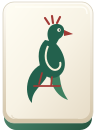
One bamboo (1 bam) mahjong tile
The one bamboo shows a bird instead of a single stick. It is the lowest tile in the bamboo suit, a terminal, and the tile some American players simply call the bird.
Learn the names and roles of mahjong suits, winds, dragons, and bonus tiles with illustrated tile references.
Last updated November 22, 2026
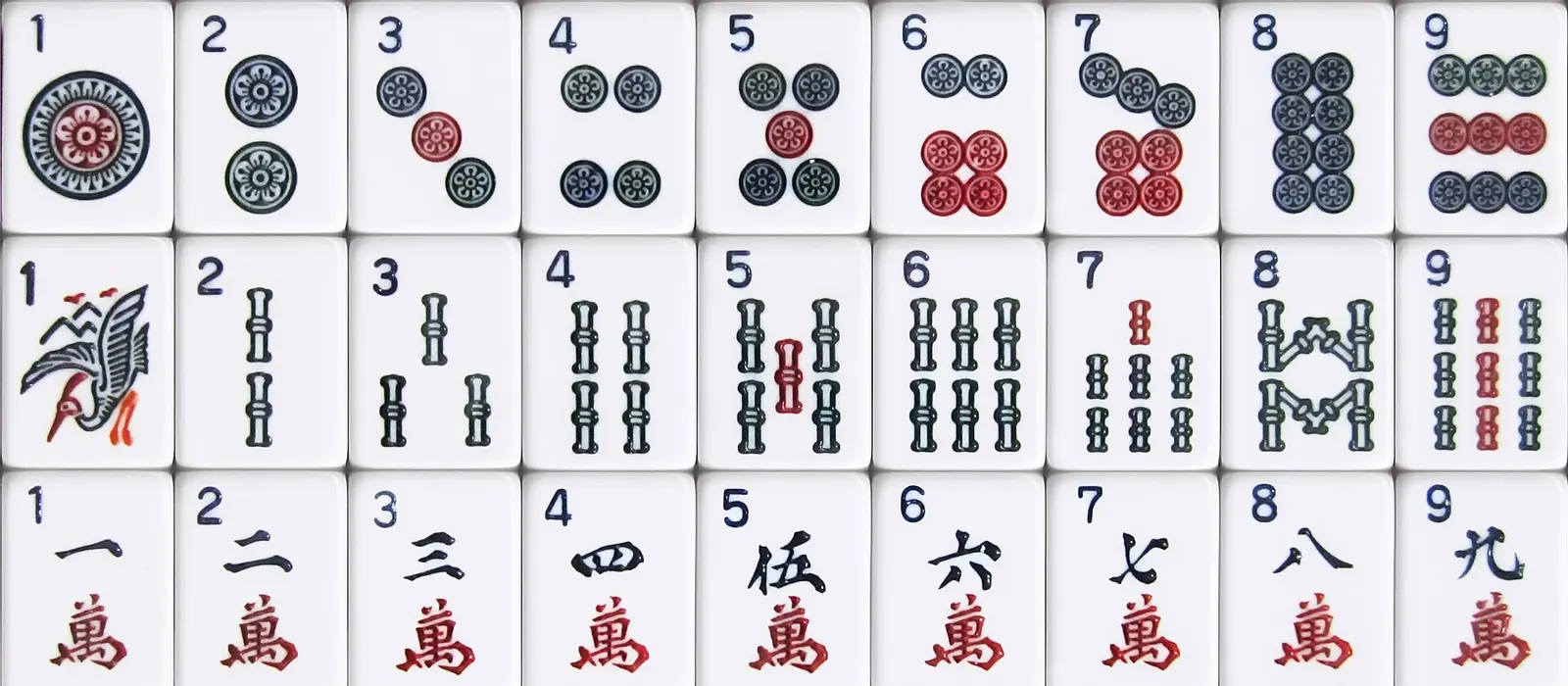
The one bamboo shows a bird instead of a single stick. It is the lowest tile in the bamboo suit, a terminal, and the tile some American players simply call the bird.

The two bamboo has two upright sticks, usually all green. It is the first simple in the bamboo suit and fits the runs 1-2-3 and 2-3-4 in styles that allow chows.

The three bamboo shows three green sticks: one on top and two side by side underneath. It is a simple tile in the bamboo suit, called san sou in Japanese play.

The four bamboo has four green sticks set out in a square, the same layout as the four dots. It is a simple tile, known as suu sou in riichi and nicknamed chopsticks (筷子) in Chinese.
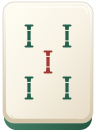
The five bamboo has four sticks at the corners and one red stick in the middle. It sits at the center of the bamboo suit and, in most riichi games, one copy is a red five that counts as a dora.

The six bamboo shows six green sticks in two rows of three. It is a simple tile in the bamboo suit, called rou sou in riichi, and it works in the runs 4-5-6, 5-6-7 and 6-7-8.

The seven bamboo has one red stick on top and two rows of three sticks below. It is a simple tile, chii sou in Japanese play, and it can be part of 5-6-7, 6-7-8 or 7-8-9.
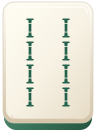
The eight bamboo is the tile whose sticks form an M shape with its mirror image, a W, above or below it. It is a simple, called paa sou in riichi, and fits the runs 6-7-8 and 7-8-9.

The nine bamboo shows nine short sticks in three rows, with the center column in red. It is the top tile of the bamboo suit and a terminal, known as kyuu sou in riichi.

The one dot has a single large circle, usually in several colors and often decorated like a flower. It is the lowest tile in the dots suit and a terminal, called ii pin in riichi.

The two dots shows two circles stacked one above the other, usually one green and one blue. It is a simple tile, called ryan pin in riichi, and fits the runs 1-2-3 and 2-3-4 of dots.

The three dots has three circles running corner to corner in a diagonal line, often green, red and blue. It is a simple in the dots suit, known as san pin in Japanese play.
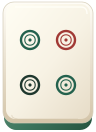
The four dots has four circles in a square, two blue and two green, with matching colors in opposite corners. It is a simple tile, suu pin in riichi, and fits 2-3-4, 3-4-5 and 4-5-6.
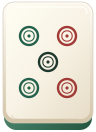
The five dots is the four dots plus one more circle in the center, often red. It is the middle rank of the dots suit, and riichi sets usually carry red versions of it that count as dora.
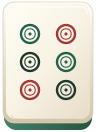
The six dots has two green circles at the top and four red circles below, with a gap between the groups. It is a simple tile, rou pin in riichi, and joins the runs 4-5-6, 5-6-7 and 6-7-8.
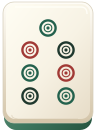
The seven dots has three green circles in a slanted line across the top and four red circles in a block below. It is a simple, called chii pin in Japanese play, and fits 5-6-7, 6-7-8 or 7-8-9.
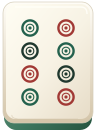
The eight dots shows eight blue circles in two columns of four. It is a simple tile, paa pin in riichi, and it can be part of the runs 6-7-8 and 7-8-9 of dots.

The nine dots has nine circles in three rows of three, with the red row always in the middle. It is the highest dots tile and a terminal, called kyuu pin in Japanese play.
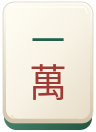
The one character shows the Chinese numeral 一, a single flat stroke, above the red character 萬 (wan, ten thousand). It is the lowest tile of the characters suit and a terminal.
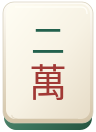
The two characters has the numeral 二, two horizontal strokes, in blue above a red 萬. It is a simple tile in the characters suit and fits the runs 1-2-3 and 2-3-4.
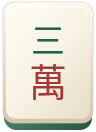
The three characters is marked with 三, three stacked strokes, over the red 萬 sign. It is a simple tile, san wan in Japanese play, and it can sit in 1-2-3, 2-3-4 or 3-4-5 of characters.
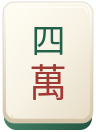
The four characters carries the blue numeral 四 above 萬 in red. It is a simple tile in the suit American players call craks, and fits the runs 2-3-4, 3-4-5 and 4-5-6.
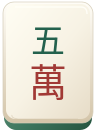
The five characters usually shows 伍, the formal way to write five, rather than the everyday 五. It is the middle tile of the characters suit, and riichi sets often include a red copy that counts as a dora.
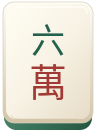
The six characters shows the numeral 六 above the red 萬 sign. It is a simple tile, called rou wan in riichi, and it can be part of 4-5-6, 5-6-7 or 6-7-8 in the characters suit.
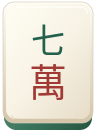
The seven characters has the numeral 七 on top in blue, with the red 萬 underneath. It is a simple, chii wan in riichi, and fits 5-6-7, 6-7-8 and 7-8-9.
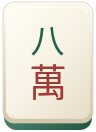
The eight characters is marked with the blue numeral 八 above a red 萬. It is the highest simple in the characters suit, known as paa wan in Japanese play.
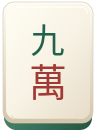
The nine characters shows 九 over the red 萬 and is the top tile of the characters suit. As a terminal it can end a run but never begin one, and in riichi it is called kyuu wan.
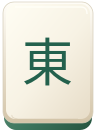
The east wind tile carries the character 東 and stands for the first seat at the table. The dealer always sits East, and play in most styles opens with East as the round wind.
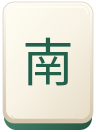
The south wind tile is marked 南 and belongs to the seat on the dealer's right. It becomes the round wind for the second round, which is why it matters so much in riichi games played over East and South.
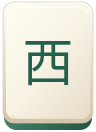
The west wind tile shows the character 西 and goes with the seat directly across from the dealer. The winds run East, South, West, North counterclockwise, so West is not to the dealer's left as on a map.
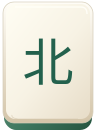
The north wind tile, marked 北, belongs to the seat on the dealer's left and is the last wind in turn order. In three-player riichi it is often pulled out of the hand as a bonus tile.
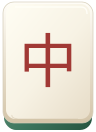
The red dragon shows the character 中, meaning center, printed in red. It is one of three dragon tiles, and in American play it is the dragon that goes with the craks suit.
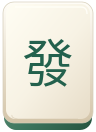
The green dragon carries the character 發, short for 發財, "to strike it rich". It is one of the three dragons, and American players match it with the bams suit.

The white dragon is the plain tile: blank, or a blue or black frame with nothing inside. American players call it soap, use it as a zero in year hands, and match it with the dots suit.

The plum flower is flower number 1, one of the four plant tiles known as the Four Gentlemen. It belongs to the East seat, so in Hong Kong and Taiwanese play it is the dealer's own flower.

The orchid flower is flower number 2 and matches the South seat. It is the second of the Four Gentlemen plant tiles found in most Chinese-style sets with 144 tiles.

The chrysanthemum flower is flower number 3 and belongs to the West seat. American sets often label it with the short form Chrys, and Chinese sets show the bloom with its character 菊.

The bamboo flower is flower number 4, linked to the North seat. Despite the name, it has nothing to do with the bamboo suit: it is a bonus tile and cannot be used in a run or set with bams.
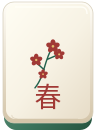
The spring season tile is season number 1 and goes with the East seat. It usually shows spring blossoms such as peonies along with the character 春.
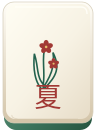
The summer season tile is season number 2, matched with the South seat. Its picture is most often a lotus, labeled with the character 夏 or the English word Summer.
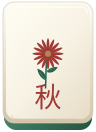
The autumn season tile is season number 3, tied to the West seat. Sets often decorate it with autumn fruit and mark it with the character 秋.
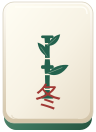
The winter season tile is season number 4 and belongs to the North seat. It commonly shows daffodils and the character 冬, which sounds the same as 東 (east) in Mandarin but is a different tile.
Find a mahjong teacher, club, or open game near you.