
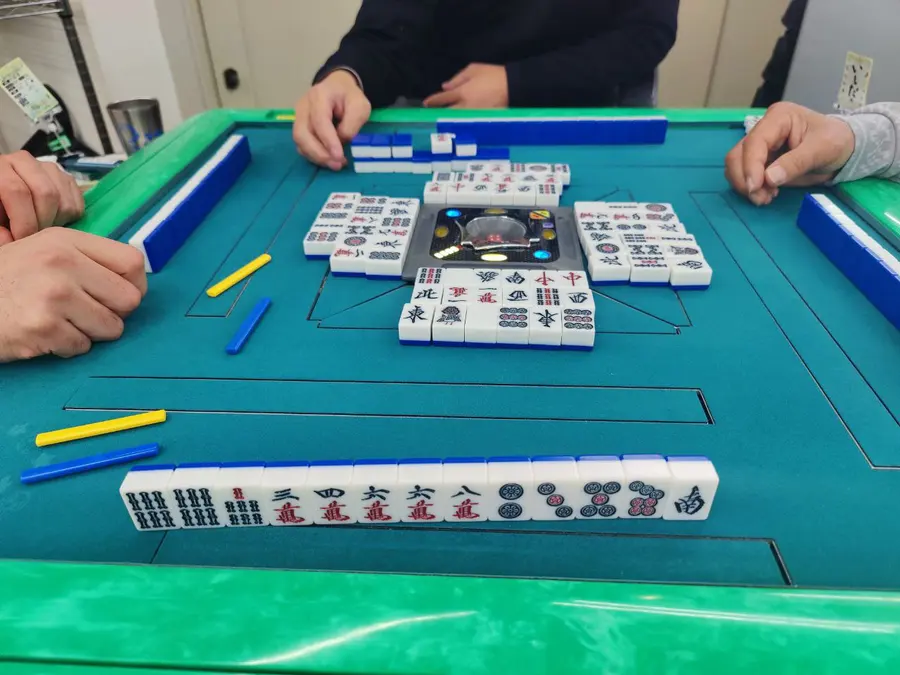
Tiles in a WRC set
You play with 136 tiles: four copies of each of 34 tiles. There are three suits (circles, bamboos and characters, numbered 1 to 9) and two kinds of honor tiles (four winds and three dragons). WRC rules use no flowers and no red fives. Many clubs and online games do add red fives, which count as extra dora, so agree on this before you start.
Seats, winds and starting points
Draw wind tiles to decide seats. The player who draws East is the first dealer. South sits to East's right, West sits across from East, and North sits to East's left. Each player starts with 30,000 points. A full game, called a hanchan, has an East round and a South round.
Building and breaking the wall
Shuffle the tiles face down. Each player builds a row 17 tiles long and 2 tiles high, and the four rows are pushed together into a square. East rolls two dice. The total tells you which side of the wall to break and where to break it.
The dead wall and the dora indicator
The last 14 tiles of the wall form the dead wall. Nobody draws from it in normal play. It supplies replacement tiles after a kan and holds the dora indicators. Turn the top tile of the third stack from the end face up: this is the first dora indicator. The dora is the next tile in order, so a 4 of circles indicator makes the 5 of circles dora, and a 9 points back to the 1.
Taking the starting tiles
Tiles are taken clockwise from the break. Starting with East, each player takes four tiles at a time, three times around. Then East takes two more tiles and the other players take one each. East now has 14 tiles and everyone else has 13.
East starts by discarding
East does not draw on the first turn, because East already holds 14 tiles. East discards first, and play then passes to South.
Draw and discard
Turns go counter-clockwise: East, South, West, North. On your turn you draw one tile from the live wall, then discard one tile face up. Put your discards in neat rows of six in front of you, in order. Order matters, because other players use your discards to judge what you are waiting for.
Calling tiles: chi, pon and kan
You can only call the most recent discard. Only the next player in turn may call chi to make a sequence. Any player may call pon for a triplet or kan for a quad. A win call beats every other call. After a kan you draw a replacement tile from the dead wall and a new dora indicator is turned over. WRC rules forbid swap-calling (kuikae): you cannot call a tile and then discard the same tile, or the tile on the other end of the same sequence.
Declaring riichi
If your hand is closed (you have called no tiles) and tenpai (one tile from complete), you may declare riichi on your turn. Say "riichi", turn your discard sideways and put a 1,000-point stick in the middle of the table. From then on you cannot change your hand: you discard each tile you draw unless it wins. WRC rules let you declare riichi even with fewer than 1,000 points, or while furiten.
Furiten
You are furiten if any tile you have discarded would complete your hand. You are also furiten until your next draw if you let a winning discard go by. If you have declared riichi, letting a winning tile go makes you furiten for the rest of the hand. While furiten you cannot win by ron on any tile, but you can still win on your own draw.
You need at least one yaku
A complete hand is four groups and a pair, seven different pairs, or thirteen orphans. To win, it must also have at least one yaku, a scoring pattern from the official list. Dora add han but do not count as a yaku. Under WRC rules an open hand of all simples (open tanyao, or kuitan) is a valid yaku.
Winning by ron or tsumo
If another player discards your winning tile, say "ron". Only the discarder pays. If you draw your winning tile from the wall, say "tsumo". All three opponents pay. If two or three players call ron on the same tile, WRC rules give the win only to the first of them in turn order after the discarder.
Exhaustive draw
If the live wall runs out and nobody wins on the last discard, the hand ends in a draw. Tenpai players show their hands. Noten players (not tenpai) pay a total of 3,000 points, shared among the tenpai players. Riichi sticks stay on the table for the next winner. WRC rules have no abortive draws, so a hand never ends early for special tile patterns.
Passing the deal
If East wins, or the hand is drawn with East tenpai, East deals again. Otherwise the seat winds rotate and South becomes the new East. The game ends when the South round is over, or earlier if a time limit is used.
Sources & last checked
- en.wikipedia.org · Checked 2026-11-23
- worldriichi.org · Checked 2026-11-23
- www.worldriichi.org · Checked 2026-11-23